Britain's Real Constitution Is a Waiting List
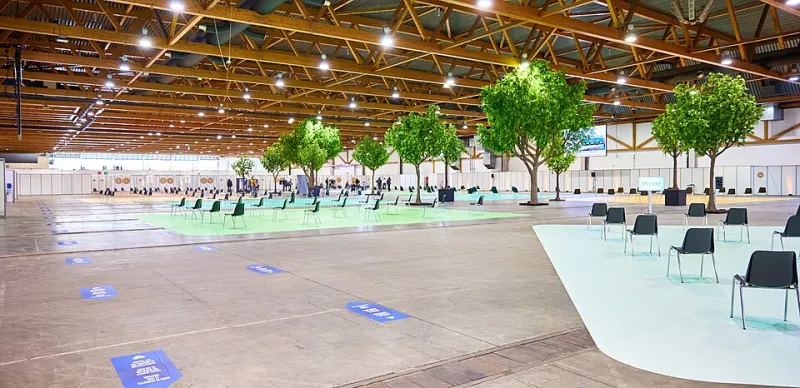
Photo: Claudio Centonze, European Commission, CC BY 4.0, via Wikimedia Commons
We like to think of ourselves as a nation that queues well. It is one of the few national stereotypes we actively enjoy: the orderly line, the muttered apology, the unspoken agreement that nobody jumps ahead. Fairness, we tell ourselves, is our quiet constitutional principle. Not written down anywhere, obviously. Just felt.
And yet the queues that actually run this country are not the ones at the bus stop or the sandwich shop. They are the ones you cannot see. The referral that sits in a system. The court date that keeps sliding. The housing register you joined in a previous life. The planning appeal that will be decided long after the developers have changed their minds. These are the queues where the state decides, in the most literal sense, who matters first.
A queue is a value judgement wearing a lanyard
Any waiting list is a set of decisions dressed up as administration. Someone, at some point, chose the order. Someone chose how many people the system could process. Someone chose which categories get prioritised and which get politely parked. None of that is neutral. It is a budget written into a spreadsheet and then translated into human time.
When a health secretary says the NHS is being reformed, the honest translation is: we are changing who stands where in the line. When a justice secretary promises to tackle the backlog, they are talking about how long an alleged victim waits for a courtroom to be free. When a council talks about housing pressures, it is talking about a family in temporary accommodation whose ticket number is essentially a lottery entry.
You can learn more about a government's real priorities from the shape of its queues than from any party conference speech. Speeches describe intentions. Queues describe outcomes.
The fair line and the invisible bypass
The romance of the British queue is that it is first come, first served. No status, no elbows, no fuss. That works beautifully in a bakery. It collapses completely in a system where the queue is not one line but a series of parallel corridors, and where the corridors have different widths depending on where you live and what you can afford.
Take geography. Two people with the same condition, the same urgency, the same needs can have radically different experiences depending on their postcode — one trust better staffed than the next, one local authority better funded, one court listing faster. We call this variation. It is, functionally, a sorting mechanism nobody voted for.
Then take money. The person who can pay privately for a scan, a diagnosis, a legal opinion, a planning consultant or a deposit gets moved sideways out of the queue and into a different lane entirely. That is not a loophole in the system. It is a feature of a system where the state's backstop has a gap in it precisely the size of a credit card limit.
And then take something subtler: the ability to work the queue. Knowing which number to ring, which form to submit, which councillor to email, which appeal to lodge. The middle-class skill of polite persistence. It is not corruption. It is just that the queue rewards the articulate, the connected and the unhurried, and it punishes the exhausted, the isolated and the confused.
What four queues have in common
Look at them side by side and the pattern is embarrassingly tidy. NHS treatment lists shrink in headline terms while the wait for the thing you actually need grows. Court backlogs mean victims wait years and defendants wait in limbo, which is its own kind of sentence. Housing registers are so long that joining them has become a ritual rather than a route. Planning appeals sit in a pile while a housing crisis is, apparently, everyone's top priority.
Different departments, different budgets, different ministers. Same underlying logic: demand is unlimited, capacity is rationed, and the rationing is decided by a mixture of clinical priority, political embarrassment and who shouts loudest. We describe this as pragmatism. It is really a rationing system that we have declined to name, because naming it would force us to say out loud what we are choosing not to fund.
One question for every promise made in 2026
There will be plenty of promises this year. Investment plans, reform roadmaps, targets, missions, delivery units, taskforces with names like verbs. Some of it will even be sincere. Very little of it will tell you the thing that matters, which is the shape of the queue at the end of it.
So here is the blunt test, and it works on every party equally. When someone announces a plan, ask who gets moved to the front. Then ask who stays where they are, holding the ticket, watching the number on the screen fail to change.
If the answer is that the urgent and the wealthy get through while everyone else waits a little longer than last year, then we have not reformed anything. We have just repainted the corridor. And if we are honest, that is the most British thing of all: an orderly, well-mannered, entirely invisible line, stretching past the end of the street, with everybody too polite to ask why it is moving so slowly.
The queue is not a technical problem on the way to something better. It is the manifesto. Read it.