The Green Belt Isn’t a Park — It’s a Land Bank With a View
There is a particular kind of British reverence reserved for the green belt. It is spoken about in the way people talk about a village church, a grandmother’s china or the last decent pub in town: not as a policy choice, but as a piece of inherited moral furniture. To question it is to sound like the sort of person who would tarmac over a war memorial.
But in 2026, with housing still expensive, rents still punishing and the planning reform argument still going round in circles, it is worth asking a less sentimental question. What is the green belt actually for? And who is it actually protecting?
A Museum Where the Exhibits Are Empty Fields
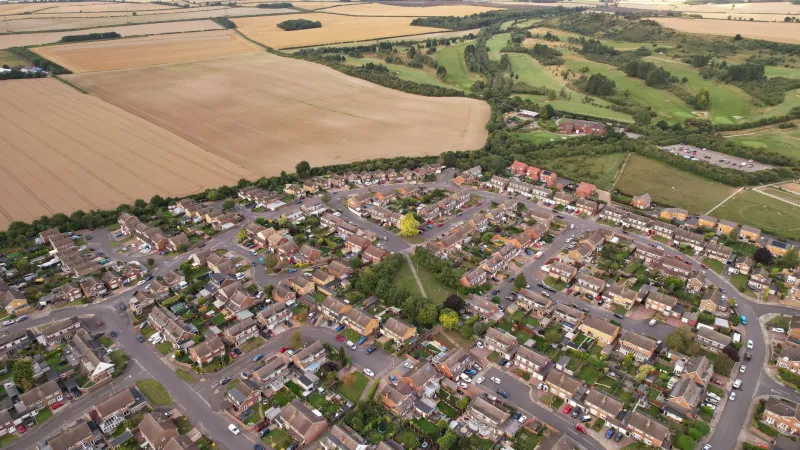
The green belt was never designed as a nature reserve. Its modern shape owes more to post-war containment than to conservation. The 1947 Town and Country Planning Act gave the planning system its teeth, and the 1955 circular encouraged local authorities to designate green belts around major cities. The aim was to stop urban sprawl — to keep London from swallowing Hertfordshire and Manchester from congealing into Cheshire.
That was a reasonable ambition. But the green belt has since acquired a halo it has not earned. Large parts of it are not rolling countryside at all. They are golf courses, pony paddocks, scrubby edges, motorway verges, derelict glasshouses and fields that exist mainly because their owners are waiting for the planning rules to change. If the green belt were a museum, the curators would have some awkward questions to answer about the condition of the roof.
None of this means every green field should be built on. It does mean that “green belt” is doing a lot of heavy lifting in a debate where beauty, scarcity and ownership have been bundled together and sold as one thing.
Scarcity Is the Product
The awkward truth is that the green belt is not just a landscape. It is a price signal.
By drawing a hard line around cities and making it extraordinarily difficult to release land, the system protects the value of what already has permission. That suits plenty of people: existing homeowners, landowners sitting on speculative plots, developers with land banks, and anyone whose pension is quietly attached to the idea that Britain must never build enough.
For everyone else, the bill arrives in the form of higher rents, longer commutes and the strange national ritual of watching a generation delay children, mortgages and settled lives while the planning committee meets again next month.
There is a fair defence of the green belt, and it is not all bad faith. People genuinely value open space. Local communities are right to be wary of badly designed estates dumped at the edge of town with no GP surgery, bus route or school. The problem is that the current system does not distinguish between protecting a beautiful landscape and preserving a scarcity machine. It treats a golf course in Surrey with the same reverence as a fragile chalk stream.
The Nostalgia Tax
Defending the green belt in its current form has become a costly exercise in nostalgia. It allows politicians to sound green without doing much for nature, and to sound local without doing much for locals who cannot afford to live there.
That is the real question underneath the planning row: who gets to own the future? If the answer is “whoever got there first, plus anyone lucky enough to inherit”, then the green belt is working exactly as intended. If the answer is “a wider group of people, including those who currently commute two hours because they cannot live near their work”, then the map needs a serious audit.
This is not an argument for paving the countryside. It is an argument for honesty. A proper debate would separate genuine environmental protection from blanket designation. It would ask why land near railway stations is treated as sacrosanct while brownfield sites sit idle. It would attach affordable housing requirements to any release. It would let local people shape the design without giving them a veto over the existence of homes. And it would admit that “we must protect the green belt” is sometimes a polite way of saying “we must protect what we already have, and the value it gives us”.
What a Better Argument Sounds Like
There is a version of this debate that is not a culture war. It starts by admitting that the green belt is not one thing. Some of it is genuinely precious and should be defended properly, with money for nature recovery and public access. Some of it is mediocre land in the wrong place, preserved mainly because releasing it would annoy the right people.
A serious planning system would be able to tell the difference. It would prioritise land near transport, insist on design quality, and capture some of the uplift for the public rather than letting it fall into the lap of whoever happens to own the field.
Instead, we have a national habit of treating the green belt as a museum piece: too sacred to touch, too expensive to maintain, and too often used to keep the door closed behind the last person in.
Britain can protect its landscapes without turning the planning map into a heritage exhibit. But that requires admitting what the current system is really conserving. It is not just countryside. It is scarcity — and the bill for admission is being paid by people who were never asked whether they wanted the ticket.
At Opin, we think that is a debate worth having beyond the headlines. The green belt is not a park. It is a choice. And we should at least be honest about who is paying for it.