The Mayor Nobody Can Explain: England’s Devolution Map Is Running Out of Road
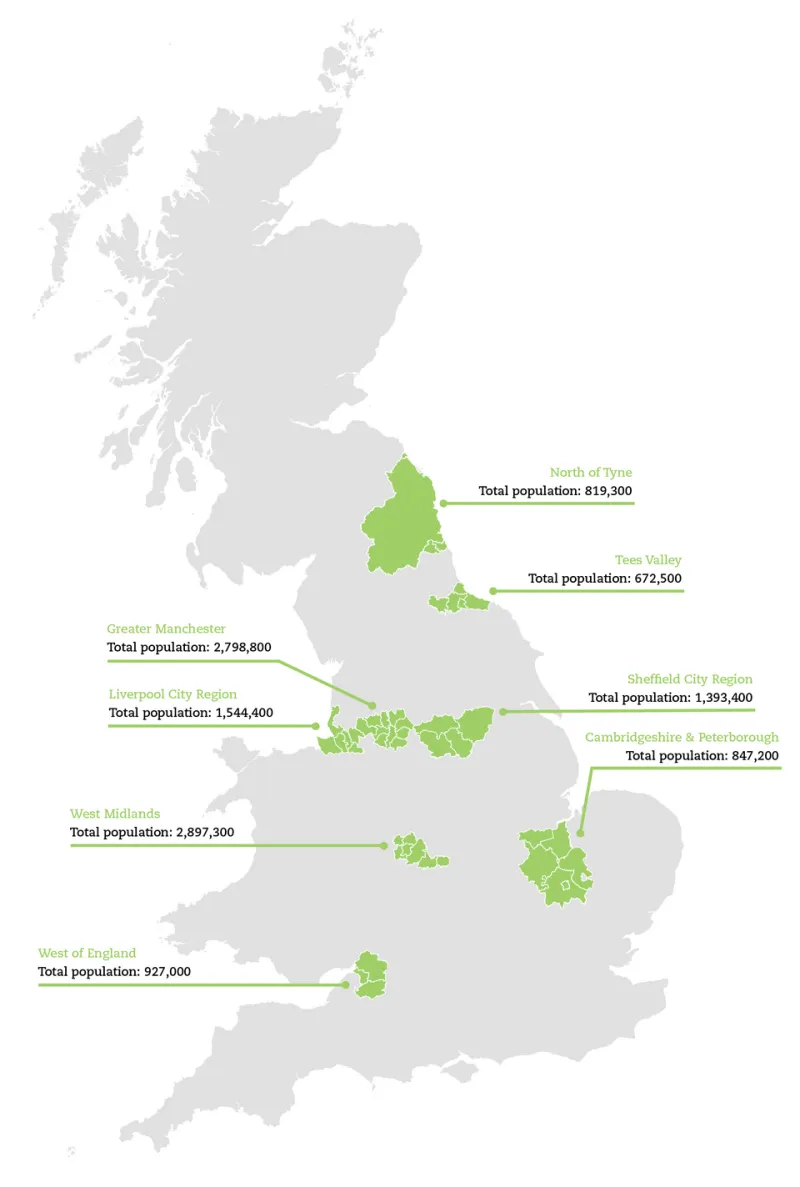
Photo: Centre for Cities, CC0, via Wikimedia Commons
Constitutional change in England rarely arrives with a bang. It arrives with a memorandum of understanding, a press release and a new logo. By the time anyone notices, there is a mayor with a mandate, a combined authority with a budget and a map that looks like it was drawn by a committee that had run out of time.
That is roughly where we are in 2026. Metro mayors have become some of the most recognisable politicians in England. They open bus routes, announce skills deals and turn up at the kind of local events where a selfie with a community group is worth more than a white paper. And yet ask a voter in any of their areas what the mayor actually controls and you will often get a pause, a guess and a reference to buses.
May’s local elections were supposed to be a showcase for this new layer of government. In some places they were. In others, the most notable feature was the turnout: dismal, even by the standards of local democracy. That is the paradox at the heart of England’s devolution experiment. It is real, it is popular in principle and it is nearly illegible in practice.
A victory for vibes
The first thing to say in defence of metro mayors is that they have done something Westminster struggles with: they have made local government feel human. A mayor can be blamed in person. A mayor can be asked a question without a freedom of information request. A mayor can say “not good enough” about a bus service and mean it.
That is not nothing. For years, the choice facing many voters was between a council leader nobody had heard of and a secretary of state nobody could reach. Metro mayors have filled a gap in the middle. They have also become useful scapegoats, which is a sign of relevance.
But recognition is not the same as accountability. The mayor will see you now — but what can the mayor actually do? The answer depends on which deal their area signed, which powers were transferred, which funding streams were devolved and which were quietly retained by Whitehall. In some places the mayor has real control over transport, skills and housing. In others, the role is closer to a regional cheerleader with a modest budget and a strong social media team.
The map is the problem
England’s devolution map is not a map in any ordinary sense. It is a layered cake of deals. There are mayoral combined authorities, non-mayoral combined authorities, county deals, city deals and directly elected leaders in places that do not quite fit the pattern. Some areas have a mayor and a police commissioner. Some have a mayor who is also the police commissioner. Some have no mayor at all and are waiting to see what happens next.
The geography follows negotiation, not function. That is the central weakness. A mayor’s boundary might reflect an old county, a travel-to-work area, a political compromise or a Treasury insistence that the deal only works if a certain council is included. The result is that the problems mayors are asked to solve — transport, skills, housing, health prevention — do not respect the lines on the map.
A bus network does not stop at a combined authority boundary. A skills shortage does not care which council area a college sits in. A housing target does not become easier because the neighbouring mayor has a different plan. Devolution was meant to join up government at a local level. Too often it has simply created a new set of boundaries for Whitehall to negotiate with.
What voters think they are voting for
Turnout is the tell. When metro mayor elections were first held, they were treated as a novelty. By the 2020s they had become a fixture, but the public’s understanding had not caught up. In 2021 and 2024, turnout in some mayoral contests was barely above 20 per cent. In May 2026, the pattern repeated in too many places.
That is not because voters are apathetic. It is because the contest is often unclear. What is the mayor responsible for? What can they change? What can they not change? If the answer requires a flow chart, the mayor has a legitimacy problem. If the answer changes depending on where you live, the system has a legitimacy problem.
The irony is that devolution is popular in principle. People like the idea that decisions are made closer to them. They like the idea of a local figure who can bang heads together. They are less keen on a system that seems to combine the worst of both worlds: local politicians with national profiles and limited powers, and national politicians with local responsibilities and no local knowledge.
Power should follow function
The strongest argument for devolution is not that it is neat. It is that it can be more effective. Local leaders know their area. They can join up transport, skills and housing in ways that Whitehall cannot. They can move faster. They can be held to account by people who actually use the services.
But that argument only works if power follows function. The question should not be “which geography can we get a deal for?” It should be “what does this place need to do, and what powers does it need to do it?” Sometimes the answer will be a mayor. Sometimes it will be a combined authority. Sometimes it will be a council. Sometimes it will be a regional body that does not fit the current template.
The current system has it backwards. It starts with a map and then asks what powers can be fitted into it. That is why so many deals look like a negotiation between central government and a set of councils rather than a settlement between government and citizens. It is also why the public conversation is so thin. You cannot have a meaningful debate about accountability if nobody can describe what is being accounted for.
The legibility test
There is a simple test for any constitutional reform: can a reasonably informed voter explain it to a friend? On that test, English devolution is failing. Most people can name their mayor. Fewer can name their council leader. Almost nobody can explain the difference between a combined authority and a mayoral combined authority, or why one area has a police commissioner and another does not.
That is not a reason to abandon devolution. It is a reason to simplify it. Publish a single, plain-English statement of what each mayor controls. Make the funding streams transparent. Stop pretending that a patchwork of deals is a coherent settlement. And give mayors the tools to do the job they are asked to do, rather than the tools that were left over after Whitehall had finished negotiating.
The quiet constitutional revolution is real. It has changed who runs buses, skills and some housing investment in large parts of England. It has produced politicians with genuine local mandates. But it has also produced a system that is hard to explain, hard to scrutinise and easy to ignore. That is a problem for democracy, and it is a problem for devolution itself.
The boring next step
The next phase of English devolution will not be won with a new logo or a fresh deal. It will be won with the boring work of making power legible. That means clearer boundaries between who does what. It means fewer overlapping responsibilities. It means funding that follows functions, not history. And it means treating voters as adults who can understand a system if someone bothers to explain it.
Metro mayors have earned their place. They are now part of the furniture of English politics. But furniture needs a room, and a room needs a plan. The map is running out of road. The next mayor who wants to be understood should start by explaining what they can actually do — and then do it.