Affordable to Whom? Britain's Housing Policy Needs a Decimal Point
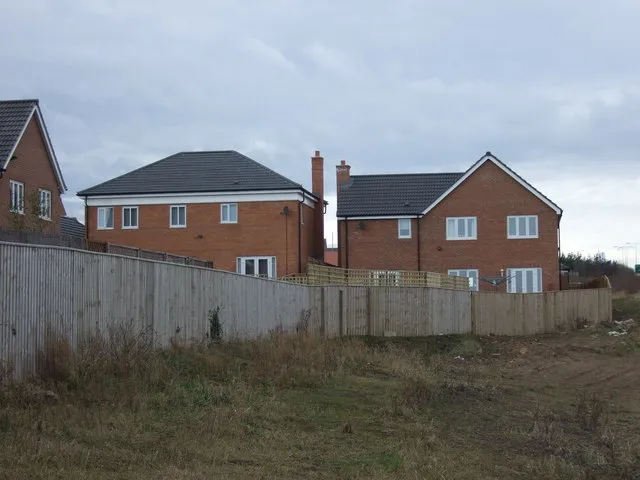
Photo: JThomas , CC BY-SA 2.0, via Wikimedia Commons
There is a word in British housing policy that can mean almost anything, and is therefore asked to mean everything. It appears in ministerial statements, in planning applications, in the small print of development agreements and on the side of hoardings. It is "affordable". And it is the only product in the country sold without a price on the label.
Ask ten people what affordable housing is and you'll get ten answers, most of them sincere, several of them contradictory, and at least two of them technically correct under current guidance. That isn't a communications problem. It's the policy.
A word with no fixed address
In England, "affordable housing" is an umbrella term covering social rent, affordable rent, intermediate rent, shared ownership and a rotating cast of discount schemes. Social rent is the genuinely cheap stuff, set through a national formula and typically far below the market. Affordable rent, by contrast, can be charged at up to 80 per cent of local market rents — including service charges. Eighty per cent of an already impossible number is still impossible; it just comes with a nicer adjective.
Then there are the ownership products. The First Homes scheme offers discounts of at least 30 per cent off market value, with price caps of £250,000 outside London and £420,000 in the capital. Starter Homes, the long-running favourite, promises 20 per cent off for first-time buyers under 40, capped at £250,000 and £450,000 respectively. Each is a real route to a home for someone. Each is also, when you look closely, a discount pegged to the very market it is supposed to offer an escape from.
The discount follows the market uphill
Here's the structural joke. A 20 per cent discount on a flat in a town where prices have doubled in a decade is a discount on a number that has already left. The definition of "affordable" moves with the market, so as the market gets less affordable, so does the affordable housing. It is the policy equivalent of a treadmill with a speed setting controlled by the person selling the treadmill.
Prices caps are meant to hold the line, but they vary by region and by scheme, and they're ceilings rather than targets. Meanwhile, service charges on new-build flats have been climbing sharply, and they land on the buyer or tenant on top of the rent or the mortgage. A discount on the headline figure can be quietly eaten by the estate's insurance policy.
None of this is a secret. Planning departments know it. Housing associations know it. Developers, who negotiate these numbers block by block through Section 106 agreements, know it better than anyone. The trouble is that everyone in the room has a reason to keep the word fuzzy, and only the people outside the room — the ones on the waiting list — need it sharp.
What the vagueness is for
A loose definition is a useful thing. For a minister, it converts a target into a deliverable. Announce 1.5 million homes, or 300,000 a year, and "affordable" lets a very wide range of tenures count towards the total. For a developer, it's negotiating room: viability assessments can argue a scheme down, and the gap gets filled with a different, cheaper product. For a cash-strapped council, it's a bargaining chip in a system where the alternative to a mediocre deal is often no deal at all.
That's why the ambiguity survives changes of government. Both main parties have promised to fix housing, and both have reached for the same generous adjective rather than a hard number, because a hard number can be missed and an adjective can't. The result is a policy vocabulary that sounds like progress and audits like fog.
Three numbers that would change the argument
The fix isn't exotic. It's arithmetic, published.
First, define affordability against local incomes, not local market rents. The standard measure — housing costs consuming no more than around a third of gross income — is imperfect but at least it's a test that can fail. Second, publish the outturn, not just the starts: what the homes actually cost to rent or buy, in the area they were built, for households on median and lower-quartile earnings. Third, separate the service charge from the rent when the figures are announced, because a subsidised rent with an unsubsidised estate charge is a magic trick performed with someone else's budget.
There's a fair objection here. Stricter definitions raise costs, squeeze viability, and can reduce the number of homes built at a time when the number is already too low. Grant funding is finite. Build costs have been brutal. Any government that nails "affordable" to a fixed formula will immediately be accused of killing schemes, and some schemes probably would die.
But the alternative is what we have now: a national housing debate conducted entirely in adjectives, in which every announcement is technically true and practically unverifiable. You cannot argue with a word. You can argue with a number, which is rather the point.
Say the price
Housing is one of the few areas of policy where the public has learned to translate the press release before it's even finished. New homes announced, yes — but what kind, at what rent, for whom, and for how long before the affordability period expires? Those are the questions that decide whether a family stays put or moves again in two years.
The cheapest reform available to any housing secretary is a drafting one: retire the word, or define it so tightly that it stops being useful to anyone with something to hide. Publish the monthly figure, in the local market, for the local wage. If a scheme can't survive that sentence, it was never affordable. It was just described that way.