The Inquiry Loop: Britain's Accountability Waiting Game
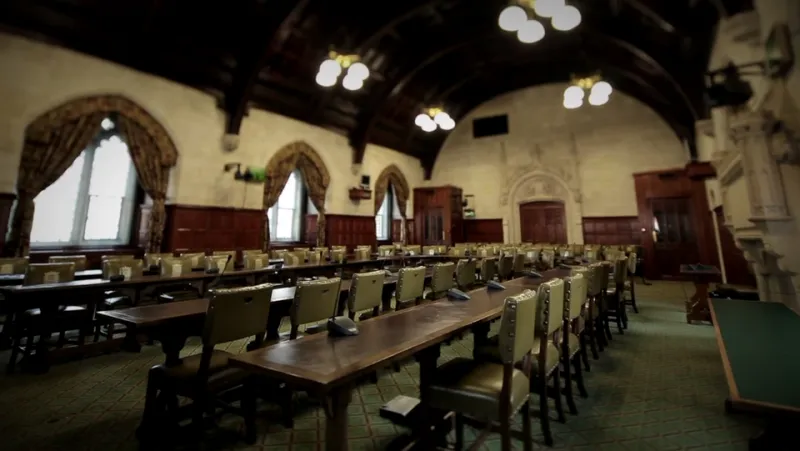
Photo: UK Parliament, CC BY 3.0, via Wikimedia Commons
The exit line
There's a sentence that does more work in British public life than any white paper: 'Lessons will be learned.' It is said in the Commons, in council chambers, in press releases sent at 4:59pm on a Friday. It sounds humble. It sounds serious. It costs nothing.
The problem isn't the sentiment. It's the grammar. 'Lessons will be learned' is passive. It doesn't say who will learn them, by when, or what happens if they don't. Compare that to 'I will learn this lesson and change this policy by March.' One is a promise. The other is a fog.
Grammar as government policy
Ministers are not accident-prone users of the passive voice. They are trained in it. When a system fails — a hospital trust, a police force, a Post Office branch — the political priority is to move the conversation from 'who did this?' to 'what process will examine this?' That's why inquiries are so attractive: they are an honourable way of changing the subject.
The inquiry becomes the answer. It is announced with gravity, given a chair, a budget and a website. It will take evidence, commission research, and publish a report. All of that is valuable in principle. But it also takes years. And in the meantime, the minister who was responsible has often moved on, the department has reorganised, and the victims have been asked to relive the worst period of their lives for a second or third time.
The inquiry economy
Britain has built a small industry around this. Inquiry chairs, counsel, solicitors, press officers, researchers, publishers. It is not a conspiracy; it's a profession. But it has its own incentives. A long inquiry is a serious inquiry. A short one looks like a whitewash. So the timeline stretches. The costs rise. The report lands with recommendations that are 'accepted in principle' — a phrase that means 'we agree with the idea but not the expense or the blame.'
Meanwhile, the people at the centre of the scandal are exhausted. They have given statements, attended hearings, sat through apologies. They are then told that the government will 'consider the findings carefully' and respond 'in due course.' That is not accountability. It is a waiting game with a legal budget.
The follow-through deficit
Real follow-through doesn't require a new quango. It requires a list, a name, a date, and a consequence. Every review should publish a closure plan: each recommendation assigned to a named official or minister, with a deadline and a status. That plan should be public, updated quarterly, and debated in Parliament. If a recommendation is rejected, the minister should have to explain why in person, not in a footnote.
Some departments already have trackers. But they are scattered, inconsistent, and rarely read outside a small circle of policy nerds. There is no cross-government register that a member of the public can search. There is no penalty for missing a deadline. There is no moment when someone stands up and says: 'We said we'd do this by June. We didn't. Here's why, and here's what happens now.'
What would actually change
A statutory 'lessons learned register' would be a start. It wouldn't need new powers; it would need a legal duty to publish. Every public inquiry, every independent review, every regulator's report would feed into one database. Recommendations would be tagged, tracked and time-stamped. Parliament's public accounts committee could publish a six-month scorecard. Victims' groups would have a standing right to see progress.
None of this is radical. It is basic project management applied to public promises. But it would change the incentives. Right now, the safest political move is to announce a review and then let it drift. If drift had a cost — a written statement, a committee appearance, a bad headline — ministers might think twice before reaching for the passive voice.
The lesson we keep not learning
The phrase 'lessons will be learned' is not a lie. It is a hope. But hope is not a policy. The UK has had decades of inquiries into infected blood, phone hacking, the Post Office, Grenfell, COVID. Each produced recommendations. Some were implemented; many were not. The pattern is not that we don't know what to do. It's that we don't build the machinery to make sure we do it.
So here's a modest proposal. The next time a minister says 'lessons will be learned', a backbencher should ask a simple question: 'Which lesson, who is responsible, and by what date?' If the answer is vague, the House should treat it as what it is: a way of saying nothing while sounding responsible.
Accountability isn't a report. It's a deadline. Until Britain gets comfortable with that, the only lesson we'll keep learning is that nothing changes.